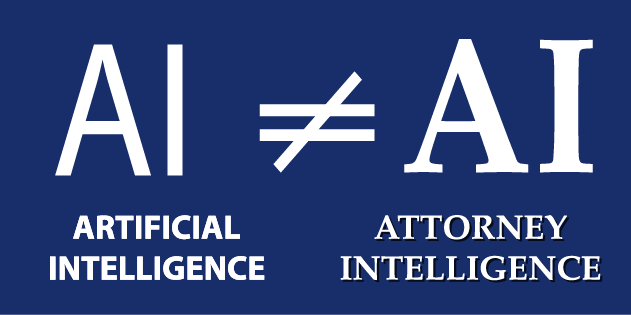
AI Does Not Equal AI
Artificial Intelligence vs. Attorney Intelligence
The phrase “just ask AI” is becoming increasingly common. Have a medical issue? A legal issue? Go plug it into ChatGPT, Perplexity or Claude. Ask Google AI.
But when you’ve been seriously injured in a wreck or hurt at work, there’s a major difference between artificial intelligence and attorney intelligence.
AI tools can summarize information. They can scan websites in seconds. They can generate answers that feel customized to your situation. As you put data in, the answers become more specific to you.
This is where the danger lies. Those answers may or may not be true. This is not a real human on the other side of those answers. It is a bot scanning the internet and taking information it finds that may or may not be applicable and tweaking it for you.
Helpful? It can be. But does it replace a human who has experience and the ability to discern nuances in people, emotions, case law and potential outcomes? No. AI cannot replace the judgment, strategy, experience, and human advocacy of an experienced injury attorney. Attorneys have an ethical obligation and personal responsibility to their clients. AI has nothing to lose if it is wrong.
Attorney and partner Adam Greene says, “Artificial intelligence, while helpful, is exactly that: artificial. The law requires the evaluation of human loss, human suffering, and human consequences. Only an experienced, human attorney can navigate the intricacies of a deposition, courtroom, or interactions with opposing counsel, and only those conversations between human lawyers and clients are privileged. The public, and attorneys, should be mindful of these facts before blindly relying on stock answers from a robot.”
Why AI Platforms Are Not the Same as an Attorney
AI Can Hallucinate
One of the biggest issues with AI platforms is something even the tech industry admits exists: hallucinations.
That means AI can provide completely incorrect information while sounding confident and presenting it as fact.
An AI platform may:
- Cite laws that do not exist
- Misstate deadlines
- Confuse state laws
- Misinterpret insurance rules
- Invent case citations
- Give incomplete answers that sound accurate
In South Carolina personal injury and workers’ compensation cases, bad information can permanently damage a claim. Missing a filing deadline, giving the wrong recorded statement, or accepting an early settlement can cost an injured person thousands — or even millions — of dollars.
An attorney is responsible for verifying facts, applying real law, and protecting your rights. Unfortunately, even some attorneys have been sanctioned for relying on incorrect AI generated case law and citing it before a judge in a case.
Just because AI says it doesn’t make it so.
AI is Not Bound by Confidentiality
Attorney-client privilege is a legal protection that keeps private communications between an attorney and a client from being revealed to outside parties, including opposing counsel, courts, or investigators. The purpose of this protection is to allow clients to communicate openly and honestly with their lawyers in order to receive informed legal guidance.
For the privilege to apply, several conditions generally must be met:
- Purpose of Legal Counsel: The communication must involve requesting or providing legal advice or representation.
- Expectation of Privacy: The discussion or exchange must be intended to remain confidential and not be shared with unnecessary third parties.
- Proper Participants: The communication must occur between the client and the attorney, or individuals working under the attorney’s direction, such as legal assistants or paralegals.
- Applies to Multiple Formats: The protection can extend to conversations, letters, emails, text messages, documents, and certain nonverbal exchanges related to legal representation.
With AI, there is no confidentiality. Conversations with an AI bot can be discovered and used against you in your case.
AI Does Not Understand Nuance
Every injury case is different. AI systems work by identifying patterns in data. But injury claims are rarely simple pattern-matching exercises. There are many factors in play that are more than one dimensional on a computer screen.
Real personal injury cases involve:
- Human behavior
- Credibility of witnesses and plaintiffs
- Medical complexity and expert witnesses
- Insurance tactics that often take place behind the scenes
- Emotional and psychological trauma
- Family impact
- Local court tendencies
- Jury perception
- Hidden insurance coverage
- Negotiation strategy
A human attorney can recognize issues an AI system may completely miss.
For example:
- A visit to the scene in a trucking case could reveal federal safety violations or a problem with the road.
- A workers’ compensation case might involve third-party liability, adding a personal injury case component.
- A commercial vehicle crash investigation may uncover umbrella insurance coverage that required months of digging and subpoenas
- A pre-existing injury may still qualify for compensation under the law
Those nuances matter and they often determine what a case settles for.
AI Only Knows What Is Input
Have you ever heard the phrase: garbage in, garbage out? This applies to AI. Artificial intelligence only knows what it knows. It can scour the internet in seconds, but it is limited by what is on the internet. It does not investigate at a human level.
It does not visit crash scenes.
It does not depose witnesses.
It does not identify contradictions.
It does not read body language.
It does not notice what someone failed to say.
AI can only respond to the information it is given or finds across the internet. It is digitally limited. Experienced attorneys know that the most important facts are often the ones missing at first.
An injury lawyer asks:
- What evidence has not been collected?
- What evidence do I need to build this case? What needs to be preserved?
- What insurance policies have not been disclosed?
- What regulations apply here?
- Who else may be responsible?
- What future medical care will this person need?
- What is this injury going to cost this family five years from now?
- Is this client a credible witness able to speak on their own behalf?
- Is the defendant a credible witness? Are they lying?
That kind of strategic thinking comes from experience — not prompts.
AI Cannot Practice Law
AI platforms are not licensed attorneys. Only attorneys licensed in the state where the case is playing out can give legal advice. Any human or machine that gives advice outside of a licensed attorney falls under the “unauthorized practice of law.”
AI cannot:
- Represent you
- Give legal advice specific to your case or tell you what to do in your case
- Appear in court
- Negotiate on your behalf
- File lawsuits
- Protect attorney-client privilege the way a law firm can
- Write letters for you that are legally sound
In many situations, relying on AI for legal guidance can drift dangerously close to the unauthorized practice of law.
And if the AI gives bad advice?
There is often nobody accountable.
A real attorney has ethical duties, professional obligations, and legal responsibility to the client.
Several pending cases including Nippon Life vs. OpenAI, highlight the dangerous extremes a chatbot can go when it acts as co-counsel in a legal case.
AI Can Steer Injury Victims, and Attorneys, Wrong
There are already examples of AI tools giving harmful legal guidance including the case citation above and the cases below which have resulted in attorney sanctions and fines.
In Mata v. Avianca, Inc., a widely publicized federal court case, two attorneys relied on ChatGPT while researching legal authority for an aviation injury lawsuit. The AI produced multiple fictitious court opinions, including fabricated quotations and citations, which were later included in court filings. After the inaccuracies were uncovered, the case drew international attention and led to significant sanctions from the court.
Morgan & Morgan vs Walmart (D. Wyoming, 2025): In a personal injury case against Walmart, attorneys with the national firm Morgan & Morgan submitted court filings that referenced eight fabricated legal decisions generated by an internal AI system. The judge later sanctioned the lawyers financially.
For injury victims searching from home, common or potential issues from AI that attorneys are seeing include:
- Telling people they “don’t have a case” when they actually do
- Encouraging quick settlement acceptance before injuries are fully understood
- Confusing state-specific laws
- Failing to recognize comparative negligence issues
- Missing workers’ compensation protections
- Misunderstanding commercial trucking regulations
- Overlooking long-term medical damages
- Rewriting legal documents and saying the AI generated content is “better” than what the attorney wrote.
Why you need an Injury Attorney if You are Seriously Injured
Human Judgment
Experienced attorneys evaluate not just facts — but people, risk, credibility, timing, and strategy.
That cannot be automated. Years of experience, training, negotiating and trial prep are not replaceable by a machine.
Investigation
Investigating a case means following the trail of clues and breadcrumbs. It is sometimes using your intuition to detect deception, reading the defendant’s body language, and identifying insurance defense attorney strategies. Our personal injury attorneys will:
- Gather and preserve evidence
- Interview witnesses
- Work with experts
- Analyze crash reports
- Preserve electronic data
- Obtain surveillance footage
- Identify additional insurance coverage
Advocacy
Insurance companies negotiate differently when they know an experienced trial lawyer is involved. If they know a case has been prepared for trial, they may be more willing to negotiate a meaningful level of compensation.
An attorney can:
- Push back against lowball offers
- Get you proper medical care
- Build leverage
- Prepare a case for trial
- Cross-examine witnesses
- Argue before a jury
AI is not capable of advocating for you during negotiations or in a court of law. Representing yourself in a serious injury case with AI as “co-counsel” puts your financial and physical recovery at risk.
Compassion and Human Understanding
Injury cases are not just financial transactions. A compassionate team of attorneys and paralegals will make you feel like family. AI often tries to check in on mental health and well-being, making those who are isolated or needing an ear to rely on it like a friend and confidant. But AI is not your friend, and it doesn’t care about you. It is, at best, a robot. In fact, multiple lawsuits are pending against AI chatbots that have advised people to kill themselves.
Injury victims are often in the darkest of places. They are wondering if they will ever recover and live a normal life again. They are dealing with:
- Pain
- Fear
- Anger
- Stress
- Missed work
- Lost wages
- Bills piling up
- Family pressure
- Uncertainty about the future
AI feels nothing. A real attorney understands the human side of a case and can help alleviate some of the worry and stress. It may be tempting to confide in AI and seek advice – it can make you feel in control of your case. However, nothing can replace the depth and compassion of a team of legal professionals working and fighting on your behalf.
Experience and Training
Experienced injury lawyers have handled real cases involving real people. They have the training and legal knowledge to bring your case to the maximum successful conclusion.
At the Steinberg Law Firm, our attorneys have spent decades handling South Carolina injury and workers’ compensation claims, negotiating with insurance companies, and litigating serious cases. For almost 100 years, we have worked in the Lowcountry. We know the laws, the courts and the people. Our knowledge comes from courtrooms, negotiations, investigations, and client relationships — not scraped internet data.
Artificial Intelligence Is a Tool — Not a Replacement
AI can be helpful for research, organization, and communication.
But when someone’s health, income, family, and future are on the line, there is no substitute for experienced legal counsel.
Artificial intelligence processes information.
Attorney intelligence protects people.
You May Also Like