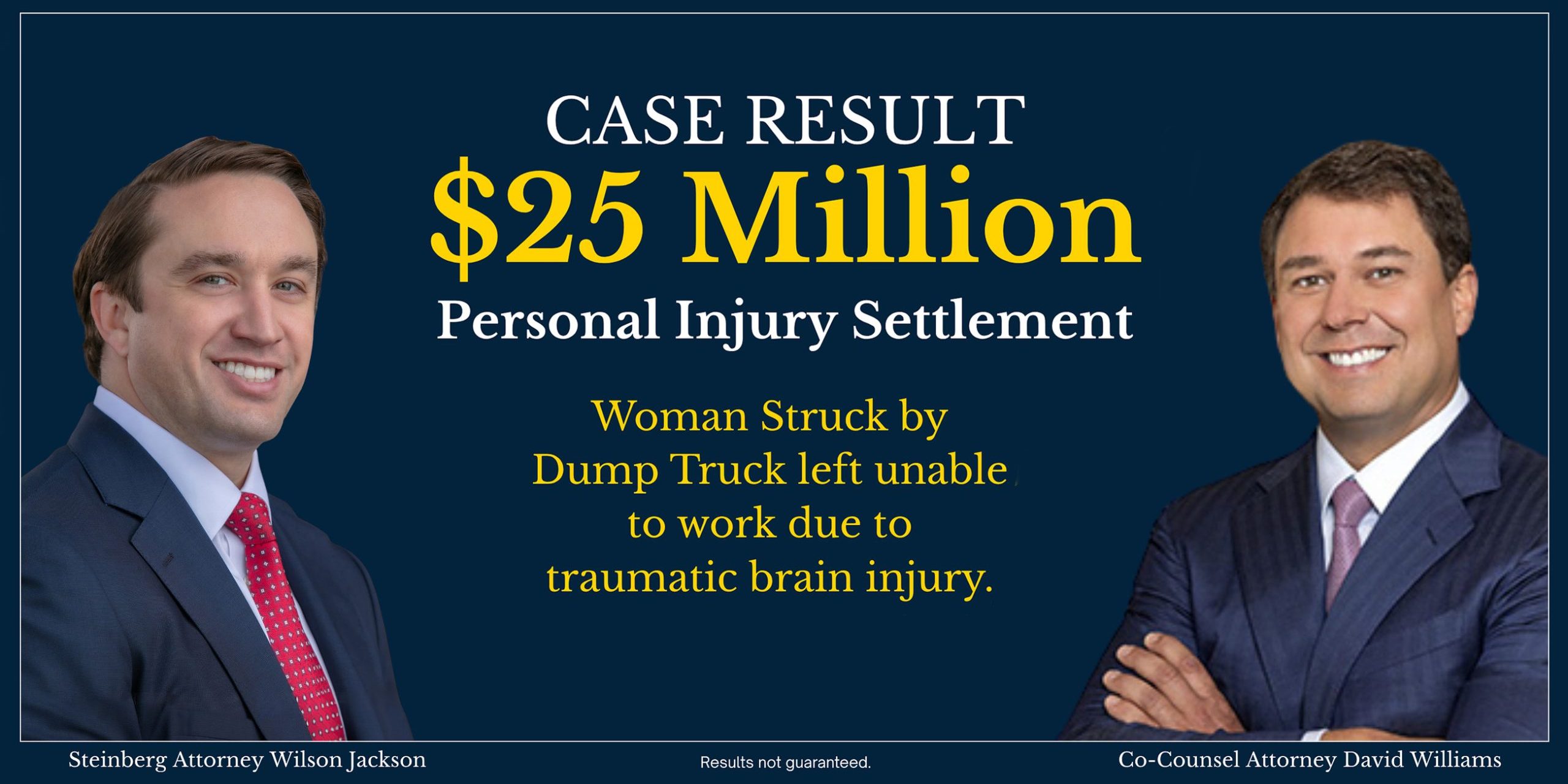
$25 Million Dollar Settlement for Client Rear-Ended by Dump Truck Whose Driver Had Been Flagged by the Company’s Dash Camera 14 Times
Steinberg Law Firm truck accident attorney Wilson Jackson and co-counsel David Williams of Williams & Williams Attorneys at Law recovered $25,000,000.00 for a client who was rear-ended by a commercial dump truck. The truck driver failed to brake and hit the victim at nearly 60 miles per hour in a 45 mph zone. The truck driver claimed he “dozed off.” However, what the evidence showed about the seven weeks before the wreck — and the three hours after it — is why the case settled.
A Dump Truck Wreck on US Highway 78 in Dorchester County
The wreck happened on a clear, dry afternoon on US Highway 78 in rural Dorchester County, South Carolina, on the stretch between Ridgeville and St. George. Highway 78 is a two-lane road through the Lowcountry that working trucks use all day long — dump trucks hauling sand, stone, and fill between the quarries and the job sites feeding the growth around Summerville and Charleston. The speed limit where the collision occurred is 45 miles per hour. The road is straight and level, and visibility that day was unlimited.
Our client was lawfully stopped at the edge of the roadway and doing her job — exactly where drivers on that road expect to encounter a stopped vehicle. A commercial quad-axle dump truck approached from behind at nearly 60 miles per hour. The truck struck the rear of her vehicle at highway speed. The impact destroyed her vehicle, and she was taken from the scene by EMS.
What the Evidence Showed
The truck was equipped with a Samsara telematics system — a dual-facing AI camera that records both the road and the driver, tracks the truck by GPS, and reports safety events back to the company in real time. The video captured the final seconds of the wreck, and the driver’s own written statement on the company’s accident form said he “went into a daze” before hitting the stopped vehicle. At his deposition, he admitted he fell asleep, admitted he was speeding, and admitted our client did nothing wrong.
Wilson and David did not stop with the dash camera video of the wreck. A court-ordered forensic download of the driver’s cell phone showed he had been awake since before 4:00 a.m. and was texting throughout his shift — in violation of the company’s own written phone policy. The download also showed something worse: within thirty minutes after the collision, the truck driver was texting his girlfriend to obtain synthetic urine, which he used to defeat the post-accident drug test his employer was required to administer according to the Federal Motor Carrier Safety Regulations.
The trucking company’s side of the file told a similar story. Its own Samsara system had flagged the driver 14 times in his first five weeks on the job — severe speeding and inattentive driving. Its own coaching records showed he was only counseled 3 times out of the 14 safety events, the last for severe speeding just three days before the wreck, and that the remedial training its own system recommended was marked “Never assigned” every time. Its own timesheets and GPS data showed the new driver was being worked up to 17-hour days, which is beyond the limits federal law allows. A company that documents a struggling driver in real time and keeps him on the road anyway has made a choice. That choice is what this case was about.
Getting that data was a fight these lawyers had before and knew how to win. When the trucking company swore it did not have access to its own Samsara data, Wilson and David knew that was not how the platform works — the motor carrier owns its data and can pull it from its own dashboard. They demanded the records by name: the safety inbox events, the coaching histories, the native driver records, the trip logs, the incident reports, and the retention settings that control how fast the video overwrites. They knew which events could be dismissed with a click, what a manually typed annotation looks like next to a system-generated one, and which reports would show who had viewed and downloaded the footage. Confronted with its own system, the company produced hundreds of pages of Samsara data it had sworn did not exist.
Our Client and Her Injuries
Before the wreck, our client had spent ten years driving the same route through rural Dorchester County. She had never been in an accident. She had never filed an injury claim. She had never treated for anxiety, depression, or any psychological condition. She had accrued forty days of vacation and forty days of sick leave for one simple reason — she never took time off. Outside of work, she was the caretaker for her disabled mother and served in the ministries of her church.
The collision changed all of it. She was diagnosed with a concussion and post-concussive syndrome — a traumatic brain injury. She never lost consciousness, and she did not need to: the medical standards followed by neurologists recognize that a concussion requires only an alteration of consciousness at the time of injury, not a blackout. Her symptoms followed the pattern brain injury specialists describe, building over the days after the wreck rather than announcing themselves in the emergency room.
Her injuries included post-traumatic headaches severe enough to require Botox injection therapy every three months, post-traumatic stress disorder centered on driving — the very thing her job required her to do all day — a cervical disc herniation in her neck, and a lumbar disc bulge in her lower back treated with ongoing injections. She worked with a neurologist, an orthopedic practice, physical therapists, and a cognitive therapist. She tried to go back to work on light duty for four months. When her employer required her to return to full duties or leave, the injuries made the choice for her. The wreck took the ten-year career she loved, and it took the version of herself that never missed a day.
Wilson Jackson and David Williams Worked the Case Together as Co-Counsel
Wilson Jackson and David Williams litigated the case together and took more than ten depositions, including the company’s corporate representative, its safety personnel, and its compliance manager; won three motions to compel; obtained a court order for the forensic phone inspection; defeated the company’s attempt to move the case out of Orangeburg County; and forced the production of the electronic safety data the company had sworn it could not access — data it later produced from its own dashboard.
Before he started representing injured people, Wilson previously represented trucking companies and their insurance carriers as part of a law firm serving as national and regional counsel for trucking companies. He has a Commercial Driver’s License and completed the Certified Director of Safety course through the North American Transportation Management Institute. He has been selected to The National Trial Lawyers Trucking Trial Lawyers Association Top 10 and Top 40 Under 40 from 2023 through 2025, named to Best Lawyers: Ones to Watch in America for 2025, and recognized as a South Carolina Rising Star in Transportation Law.
David Williams of Williams & Williams Attorneys at Law is devoted to civil litigation, including automobile and tractor-trailer collisions, insurance bad faith, and wrongful death. David is AV rated, is a Fellow of the Litigation Counsel of America, and has been recognized by Super Lawyers, Best Lawyers, and The National Trial Lawyers Top 40 Under 40. He is the third generation to lead Williams & Williams, continuing a legacy of relentless advocacy and community service that dates to 1936. From offices in Columbia and Orangeburg, the firm’s trial lawyers serve clients across South Carolina.
Why This Evidence Has to Be Preserved Quickly
The evidence that decides a trucking case is often the evidence that disappears first. In this case, the truck’s continuous camera footage was set to overwrite itself. The truck itself was repaired the day of the wreck, returned to service the next morning, wrecked again, and later sold for scrap — before it could ever be inspected. The GPS data behind the driver’s timesheets was not saved. Steinberg Law Firm sent preservation letters by certified mail within days of the collision and spent the entire 18 months of litigation seeking to collect evidence that was hidden by the trucking company. The safety alerts, the coaching records, and the phone data survived because someone demanded them in time.
Injured in a Truck Accident in South Carolina?
Steinberg Law Firm represents people injured in commercial truck wrecks in Summerville, Goose Creek, Charleston, and throughout South Carolina. The firm has served injured South Carolinians for nearly a century and has recovered more than $1 billion for its clients. If you or a member of your family has been seriously hurt in a collision with a commercial truck, call us and tell us what happened.
Call 843-720-2800 for a free consultation. There is no upfront fee.
*Disclaimer: Prior results do not guarantee a similar outcome. Settlement amounts are stated before the deduction of attorney’s fees and case expenses.
You May Also Like