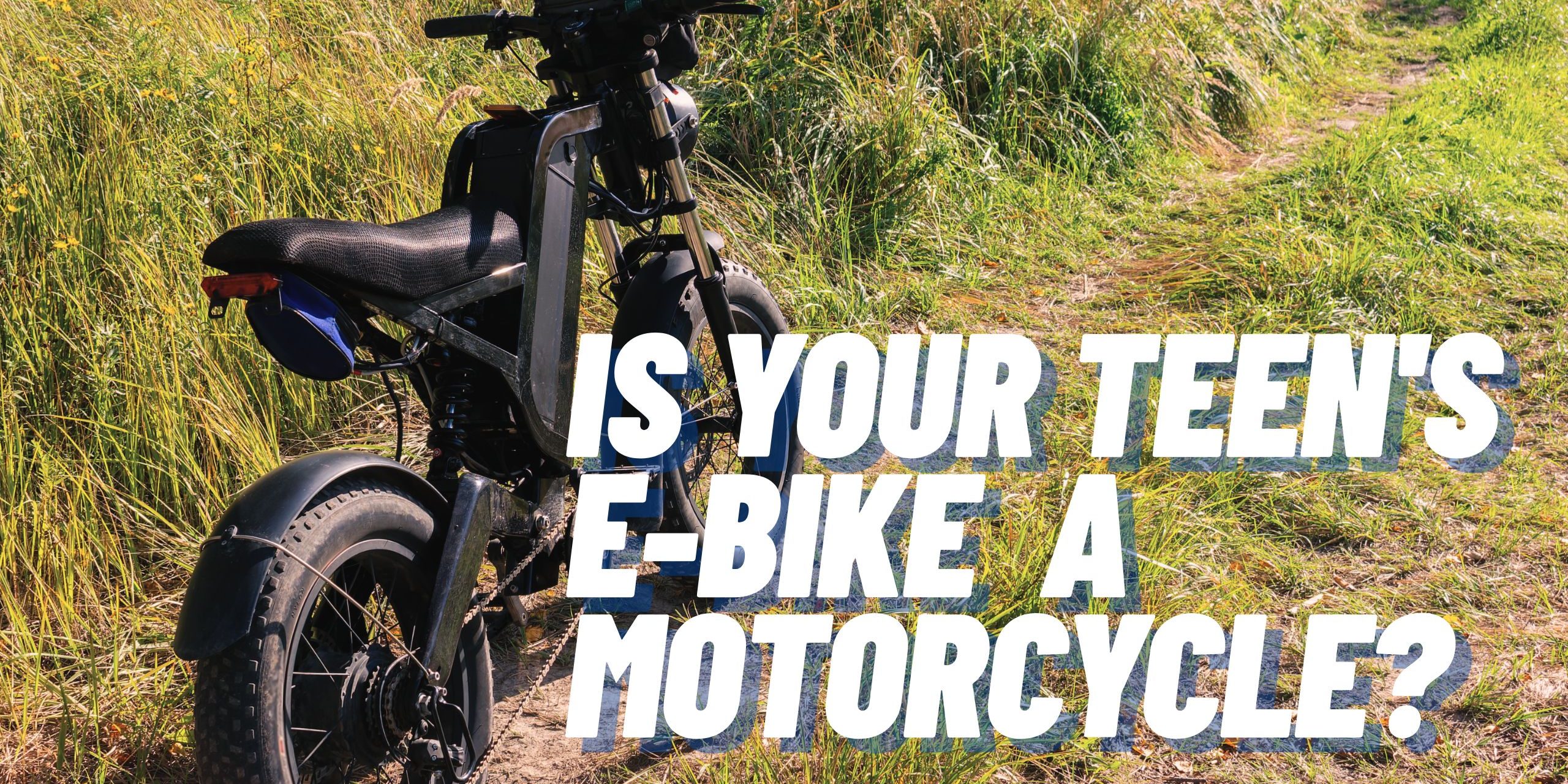
Is Your Teen’s E-Bike Really a Motorcycle? South Carolina Electric Bike Laws Lowcountry Parents Need to Know
Recently, the Mount Pleasant Police Department posted disturbing video footage on Facebook. The video showed a pack of teens on e-bikes and electric dirt bikes cutting through a walking path, blowing a stop sign, riding at dusk without lights, and narrowly missing a pedestrian pushing a stroller. The teens also ignored a police car’s blue lights and siren, continuing to ride instead of pulling over, as South Carolina law requires.
But this isn’t just a Mount Pleasant issue; incidents involving teens riding e-bikes recklessly are happening across the Lowcountry and throughout South Carolina. Although the exact number is not officially reported, serious e-bike crashes can occur in North Charleston, Summerville, Goose Creek, Columbia, and Aiken. These situations raise tough questions about liability if a teen collides with a pedestrian, hits a car, or is seriously injured themselves.
Depending on the circumstances, the teen, their parents, and even the e-bike seller or modifier could share responsibility. It’s important for families and communities to understand who may be held accountable when an electric bike ride goes wrong.
South Carolina E-Bike Laws for Teens: What Parents Are Responsible For
“Talk to your kids,” the Mount Pleasant Police Department wrote. “This behavior is not only illegal, it’s dangerous…and happening too frequently.”
Arguments erupted in the comments to the Facebook post and elsewhere online. While the Mount Pleasant Police Department noted that both parents and teens can face charges when teens ride e-bikes illegally, opinions are sharply divided over who should take responsibility for these road risks.
Nearly all arguments have one thing in common: The participants aren’t clear on how South Carolina defines “e-bikes” in its laws. Understanding what counts as an e-bike, and what doesn’t, can help both parents and children make smarter, safer choices.
*Disclaimer: This blog is for educational and informational purposes only. Steinberg Law Firm is not directly involved in the situations mentioned and is not representing any parties in any case. Reading this blog does not establish an attorney-client relationship.
What Counts as an E-Bike in South Carolina? (And What’s Really a Moped or Motorcycle)
What is an “e-bike,” exactly? Title 56, Chapter 1 of the South Carolina Code defines a bicycle as a device propelled solely by pedals, but does not separately define “e-bike” or “electric-assist bicycle” as distinct vehicle categories. The South Carolina General Assembly passed H.3174, which the Governor signed into law on February 3, 2020 (Act No. 114). The law defines “electric-assist bicycles” and establishes regulations for their use on public roads, which seeks to fill this gap.
H.3174 would amend Section 56-1-10 of the South Carolina Code to define “electric-assist bicycles” and “bicycles with helper motors” as “low-speed electrically assisted bicycles with two or three wheels, each having fully operable pedals and an electric motor of no more than 750 watts, or one horsepower, and a top motor-powered speed of less than twenty miles an hour…”
In short, an “e-bike” has pedals and a low-speed electric motor that can’t push the bike faster than 20 miles per hour. What’s NOT an e-bike, even if it’s parked in the same garage:
- Electric dirt bikes and e-motocross machines, including many models marketed as electric dirt bikes for teens. Think models by Sur-Ron, Talaria, and lookalikes. These have no pedals and are not recognized as “bicycles.”
- Throttle-only builds, especially if they greatly exceed the 750-watt/one-horsepower power ceiling. These, too, have no pedals and aren’t recognized as “bicycles.”
- “Off-road use only” bicycles that are nevertheless ridden on public streets and neighborhood paths.
Some examples are easy to spot. Others are harder, especially because a legal bike can be modified to become an illegal one. Swapping controllers, de-restricting the bike or its apps, removing speed limiters, installing aftermarket batteries, and similar modifications can double an e-bike’s top speed. An e-bike sold to meet South Carolina’s definitions can be altered to violate them instead.
Common E-Bike Accidents Involving Teens on Modified Electric Bikes
Teens riding altered e-bikes and electric dirt bikes are at higher risk of crashes. These collisions show similar patterns. For example, collisions are more likely when drivers can’t judge a bike’s speed. Drivers rely on several cues to estimate a bicycle’s speed, including a rider’s posture and how hard the rider is pedaling.
On an e-bike, however, a rider can be sitting upright, perfectly still, yet still traveling 20 miles per hour, or faster if the e-bike has been altered. A driver misjudges the bike’s speed by 20 miles per hour, and a crash results.
E-bikes can also increase the risk of collisions with walkers, runners, dogs, strollers, and other path users. Even coming off a path can be risky. Drivers do not expect vehicle-speed traffic to shoot off a bike path onto a road, especially in the middle of a block. They may be unable to react in time to prevent a crash. Other high-speed electric vehicle risks include:
- Collisions between slow-moving golf carts and fast-moving electric vehicles,
- Two or three riders piling onto a machine built for a single rider,
- Group riding, racing, and stunting, especially while also trying to film for social media,
- Riding an electric bike after dark without adequate lights or reflective clothing,
- Loss of control of an electric bike, at speeds the frame, brakes, and tires were never rated to handle, especially on altered e-bikes, and
- Battery fires and thermal events are more likely in modified or aftermarket builds.
As adults, many of us remember doing similar things on bicycles when we were kids. We’d balance a friend on the back of a bicycle seat, show off our ability to pop wheelies, or ride home after dark without lights. On high-speed electric bicycles, however, the stakes are higher.
Why Electric Bike Injuries Are More Serious for Kids and Teens
In a word: speed. E-bike, e-moped, and e-motorcycle riders often wear street clothes. In the summer, this may mean tank tops or T-shirts, shorts, and sneakers. Helmets, gloves, leather jackets, boots, eye protection, and Kevlar protective gear are often absent.
- In a collision, head injuries are more likely. Concussion symptoms may not be immediately evident, making it more likely parents will miss them.
- Facial and dental trauma is more likely as well. This damage is often permanent, and it’s less likely to be covered by health insurance.
- Many adults have stories about how they broke bones as children. At 30 miles per hour or more, broken bones are usually more severe than they were when we fell off swings or slipped on a skateboard.
- Damage to growth plates can cause children to suffer permanent deformities, pain, and loss of mobility as their bones grow.
Road rash and degloving injuries at high speeds can be traumatic, causing intense pain, long recovery times, deep trauma, and lifelong scars. The teens riding these bikes aren’t the only ones at risk in a crash. Pedestrians can suffer hip and head injuries, especially if they’re older or frail. Teens may collide with families, including babies and children in strollers, leading to injuries.
The costs of a high-speed crash start with serious injuries, but they don’t end there. Additional costs to a teen’s physical, mental, and emotional health include facing surgeries and hospital stays, missing school, losing out on sports, attending therapy, and the need for long-term care in some cases.
What to Do After an E-Bike Accident Involving Your Child
After an e-bike crash, get medical care first. Document medical symptoms in the days following the incident. Some symptoms take hours or even days to become fully apparent.
- Call law enforcement, even if it feels like there is “nothing to report.” A written record helps establish date, time, location, witnesses, and who was involved. This information forms the basis of an insurance or legal claim.
- Take photos before anyone repairs, resets, or alters it. Take detailed photos of controllers, batteries, displays, app settings, and every aftermarket part.
- If you own the bike, don’t modify or fix it. Keep the helmet, no matter what shape it is in. Even a helmet that looks “fine” may have detectable damage inside that can provide evidence to back up an injury claim.
- Document the path or street, including any signs and their position relative to the crash site.
- Talk to local witnesses. Ask for copies of any footage from doorbell cameras, community gate and amenity center cameras, or dash cams.
- Speak to an e-bike accident lawyer promptly. Wait to notify the homeowners’ insurance carrier until after you’ve had this conversation. When you do notify insurance, do so in writing.
Don’t discuss the crash on social media. Don’t argue about it on Facebook, Nextdoor, or any other community page. Don’t post video from the crash. Don’t have your teen explain it. Remind your teenager not to talk about it on social media, either. Insurance companies can and do mine social media posts for evidence and information they can use to deny your claim. If insurance denies or delays your claim, talk to a lawyer. A law firm can answer your questions, focusing on your specific situation. Attorneys can also gather evidence for a clear picture of what happened.
E-Bike Safety Tips for Lowcountry Parents, POAs, and HOAs
When parents and communities worry that nothing will change until someone gets hurt, it’s often for good reason. Legislative changes move slowly. Here’s what parents, POAs, and HOAs can do to reduce risks and help everyone stay safe.
- Parents: Know what you’re buying before you open your wallet. Double-check a machine’s pedals, wattage, top speed, whether it is street legal in South Carolina, and whether it has to be registered. Ask the shop whether the bike can be de-restricted and what happens to its legal status if speed restrictions are removed.
Give your teens “driving lessons.” Merely saying “be careful” doesn’t help, 14 year olds lack the experience to judge whether certain speeds are “careful.” Show your teens how to operate their e-bike, where they can ride, and what to wear, including helmets. Add lights to the bike if your teen will be riding at dawn, dusk, or after dark.
- POAs/HOAs: Revise your community rules. Specify which bike classes are allowed on paths, and put the specifics on path signs. “No motorized vehicles” doesn’t clarify which types of e-bikes, if any, are allowed. Instead, list bike classes and state whether each is allowed or not.
Get specific about consequences, as well. What happens if someone is caught riding a prohibited vehicle on the paths? Are their amenities suspended? Do they lose gate access? Clarify the rules and communicate them widely. Coordinate with the local police department so that everyone is clear about who is responsible for which areas of the community.
Is a Modified E-Bike Street Legal in South Carolina?
Once an “e-bike” goes faster than South Carolina’s definition allows (20 mph), it is no longer defined as an “electric-assist bicycle.” Instead, it falls under Title 56, Chapter 1’s definitions of a “moped” or a “motorcycle.”
- In South Carolina, mopeds and motorcycles are subject to license, registration, insurance, and minimum age requirements.
- You must be at least 15 years old to obtain a moped license in South Carolina. If you are a moped driver under the age of 16, you are allowed to ride alone during daylight and during nighttime if a 21-year-old with at least 1 year of driving experience is present.
If you’re a parent thinking, “But I had no idea!” you’re not alone. After all, you bought your teen a ride with handlebars and a seat. It looks like a bicycle. Nowhere on the website or at the bike shop did anyone say the word “motorcycle” or “moped.” You did your best with the information you had. Unfortunately, that information was incomplete, an issue that H.3174 seeks to fix.
Where E-Bike Problems Are Showing Up: Mount Pleasant, Summerville, Goose Creek, and North Charleston
The Mount Pleasant Police Department post is just one example of a place where teens ride electric-assist motorcycles or mopeds, thinking they count as “e-bikes.” Other riders and issues have popped up in Summerville, Goose Creek, Hanahan, and North Charleston. And the problem isn’t limited to the Lowcountry: families in Columbia, Aiken, and other South Carolina towns are facing the same questions about electric bikes.
Master-planned communities with extensive path networks, such as Nexton, Carnes Crossroads, and Cane Bay in Summerville and Goose Creek, have reported accidents. Other hotspots like the Moncks Corner area, Daniel Island in Charleston, and Park West and Carolina Park in Mount Pleasant also have heavy e-bike traffic, including e-bikes, electric motorcycles, and mopeds.
It’s important to note that many multi-use and walking paths in these areas have signs reading NO MOTORIZED VEHICLES.
- A Class 1 pedal-assist e-bike, which typically reaches speeds of 20 miles per hour, depends on local ordinances, according to Rideright.org.
- An electric dirt bike capable of reaching 45 miles per hour can be highly dangerous if not operated safely on bike paths, roads, or other areas.
The problems compound when riders don’t follow posted rules. Bike paths often have rules and guidelines posted on signs along the path.
- On public roads, travelers must follow road rules, whether they choose a car, a manual bicycle, a low-speed e-bike, a moped, or a motorcycle.
- Riding irresponsibly and inexperience on streets, not following (or even knowing) traffic laws, doing wheelies in neighborhoods, tailgating cars, blowing stop signs, and weaving on and off sidewalks all pose risks to the rider and everyone around them.
School routes, beach access paths, and shopping center cut-throughs also face risks. These fast electric motorcycles and mopeds pose particular issues in neighborhoods where residents are already used to sharing streets with golf carts, which move slowly but stick to the road rules. Adapting to the arrival of fast, silent, unpredictable traffic poses an extra challenge.
Why E-Bike Enforcement Is Stuck in South Carolina Communities
You bought your child what you thought was an e-bike, only to realize you might not have gotten what you expected. You want to keep your child safe, but you don’t want to take away a source of enjoyment and a means of transportation they may now rely on. Who is responsible here? Who can you lean on, and what consequences can you expect?
As with many advances in technology, use of e-bikes, e-mopeds, and e-motorcycles is outpacing rulemaking. Responsibility is a work in progress, leaving many parents and community members feeling stranded. Even professional rulemakers and enforcers can feel at a loss. POAs and HOAs can write rules, but they cannot enforce state traffic laws. Law enforcement officers can enforce state traffic laws on public roads and sidewalks, but they often cannot enforce POA rules on private paths.
The result? Residents feel unheard when they worry about kids tearing through their neighborhoods on high-speed electric rides. Parents feel targeted when they did their best with the information they had. Kids and adults who legally ride e-bikes are unfairly blamed. Law enforcement tries to get the word out, but is limited by the rules of the job and the existing (or absent) state laws. Everyone fears that nothing will change until someone gets seriously hurt.
Who Is Liable for an E-Bike Accident Involving a Teen in South Carolina?
When a teen on an e-bike or electric dirt bike crashes in South Carolina, who is responsible? The question is complicated by the fact that a teen is a minor. South Carolina evaluates a minor’s negligence – and the share of fault assigned to them – on a case-by-case basis. A court will ask whether the specific minor acted with the care reasonably expected of a minor of the same age, experience, intelligence, and capacity, in a similar situation.
Parents can also share fault when a teen causes an unexpected electric bike crash. Courts may ask whether the parent or guardian negligently entrusted the minor with the vehicle and whether the parent or guardian helped modify the bike (legally or otherwise). Under Section 56-5-6130, a parent or guardian shall not authorize a child to violate the provisions.
Insurance can complicate matters, too. When a family member crashes on a bicycle, many homeowner’s policies cover injuries and losses. However, the same policies that cover a bicycle often exclude motorized vehicles. An “e-bike” that actually falls under South Carolina’s definitions of a moped or motorcycle can fall outside the policy. Most families don’t find out that their child’s e-bike isn’t covered until after a crash.
Does Homeowners or Auto Insurance Cover an E-Bike Accident in South Carolina?
What about auto insurance? Typically, auto insurance won’t cover motorized vehicle crashes unless the specific vehicle is listed on the policy – even if the vehicle is a motorcycle, moped, or modified e-bike. Uninsured/underinsured (UM/UIM) coverage may or may not cover the crash, depending on the facts.
Families and injured community members can find it tough to know where to turn after a collision. Options that may be available in some cases include:
- The driver of a car was involved in the crash. Drivers who cause these incidents through negligence are still liable for their actions. The fact that a teen was riding illegally doesn’t automatically end that liability.
- A seller, importer, or shop that modifies or de-restricts e-bikes. In crashes where brake, frame, or battery failures cause harm, the manufacturers or designers may be liable.
A POA, HOA, or property owner. Bike paths that are dangerously designed or lack signage may give rise to liability. POAs or HOAs that receive notice of ongoing problems and do nothing may share responsibility as well.
South Carolina’s comparative negligence rule bars recovery for a person who was 51 percent or more at fault in a crash. In e-bike crashes involving a minor, this rule can cut in both directions. Talk to a knowledgeable attorney to learn how the rule might operate in your specific case.
Talk to a Charleston-Area E-Bike Accident Lawyer at Steinberg Law Firm
Whether you’re the parent of a teen injured on an electric ride or a pedestrian or bicyclist who suffered a crash, Steinberg Law Firm can help you navigate the legal aftermath. Contact us today to speak with an electric bike accident attorney about your case.
Call us at (843) 720-2800 to schedule a free consultation. We have offices in North Charleston, Goose Creek, and Summerville, and we help families throughout the Lowcountry, including Charleston, Mount Pleasant, Hanahan, Ladson, and Moncks Corner.
You May Also Like